Turquoise Identifier
Instant AI analysis to authenticate and evaluate gemstones from photos
Identification form
Upload turquoise photos
Clear, well-lit images help the AI identify it more accurately.
Unlock Unlimited Access
- Unlimited Identifications
- Unlimited AI Chat Messages
- Save and Organize Your Collection
How to Identify Turquoise in 5 Steps
- 1
Snap a Clear Photo
Click "Upload Images" to select your picture. For accurate gemstone analysis, ensure the turquoise is well-lit (natural daylight is preferred) and placed against a neutral, plain background to highlight true color saturation.
- 2
Capture Details & Angles
Upload multiple angles to help the AI. Close-ups of the matrix (the web-like veins), surface texture, and any potential white spots or dye concentrations provide vital clues for authenticity.
- 3
Provide the Location
Tell us where the specimen was acquired or found. Origin is a massive factor in turquoise valuation—a stone from the Sleeping Beauty mine differs significantly from Chinese or Persian varieties.
- 4
Add Observations
Input specific traits to narrow down the results. Note the luster (waxy is typical for genuine stones, while glassy might indicate plastic), hardness, or if the color looks uniform versus variegated.
- 5
Get Instant Results
Click "Identify Turquoise" to start the analysis. Our system compares your photos against a vast database of mineral samples to determine authenticity and potential mine origin.
Ready to identify it?
Upload one or more clear photos to get started.
The Science and Allure of the Sky Stone
Turquoise is a hydrated phosphate of copper and aluminum, beloved for centuries for its unique hue and matrix patterns. To the untrained eye, many blue stones look identical, but a closer look reveals a complex world of geological fingerprints. The primary factor influencing the color is the mineral content in the surrounding ground where the stone formed. Copper content drives the vivid blues that are often most prized, while the presence of iron tends to shift the color toward greener shades. This variability is a key marker in distinguishing stones from different regions.
Beyond color, the physical texture is a crucial indicator of quality. Genuine high-grade specimens typically possess a waxy or sub-vitreous luster, rather than the glassy shine often seen in glass imitations or the dull matte finish of soft plastic fakes. Hardness also varies; while generally ranging between 5 and 6 on the Mohs scale, chalky varieties can be softer and require stabilization. Understanding these physical properties is the first step in successful verification, allowing collectors to look past the surface color and assess the structural integrity of the gem.
Distinguishing Genuine Stones from Imitations
The market is flooded with imitations, making verification essential for any buyer. One of the most common mimics is dyed howlite, a naturally white and porous borate mineral that absorbs blue dye easily. While it can look convincing at a glance, howlite often retains the dye in the cracks of the webbing, creating fine lines that appear darker and more unnatural than the matrix of a genuine stone. Another common fake involves reconstituted blocks, which are essentially dust mixed with resin and compressed into shape. These often display a suspicious uniformity in color and pattern that nature rarely produces.
To spot these imposters, examine the matrix pattern. In natural specimens, the host rock (matrix) runs through the stone in irregular, three-dimensional paths. In plastic or resin fakes, the webbing is often merely surface-deep or looks too perfect. Additionally, looking at the drill holes of beads can reveal the white center of dyed stones. Destructive tests, such as the hot pin test, can identify plastic (which melts and smells acrid) versus stone, though visual inspection and specific gravity checks are safer, non-destructive methods preferred by enthusiasts.
Decoding Origin through Matrix Patterns
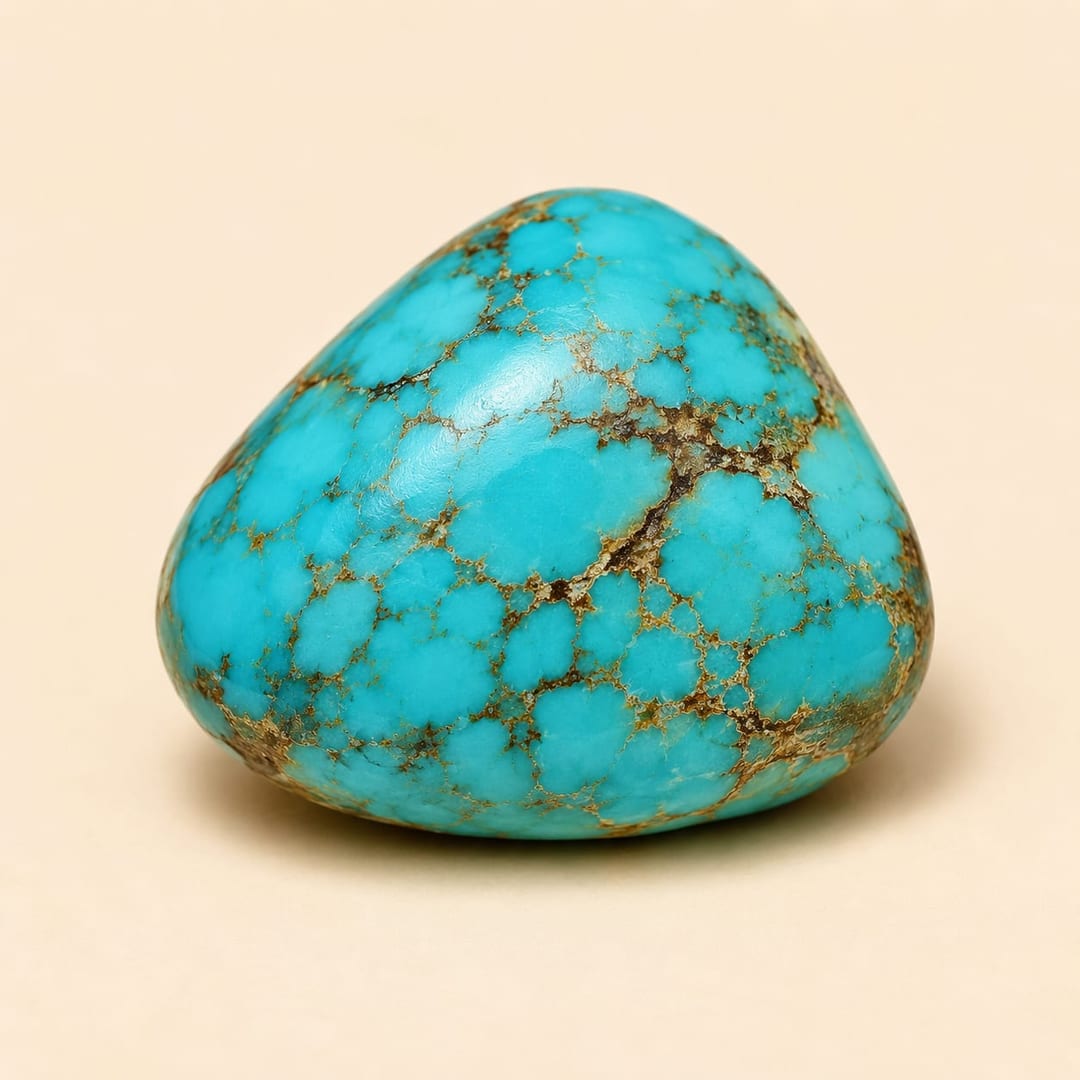
The "fingerprint" of any turquoise cabochon is its matrix—the remnants of the host rock in which it formed. This matrix can range from the golden-brown limonite of Nevada mines to the metallic pyrite flecks found in Persian or Morenci stones. For collectors, the matrix configuration is not just an aesthetic choice but a map of origin. A "spiderweb" pattern, where the matrix forms a delicate net over the blue background, is highly sought after and increases value significantly. Conversely, stones like those from the Sleeping Beauty mine are famous for having little to no matrix, presenting a pure, solid sky-blue color.
Geography plays a massive role in value. American mines, particularly those in Arizona and Nevada, produce some of the world's most collectible variations. Meanwhile, historical sources in Iran (Persia) are known for a specific robin's egg blue that sets the standard for the industry. Chinese mines produce a vast quantity of the world's supply today, ranging from high-quality material to chalky stones that require treatment. Recognizing the subtle differences in the host rock color and the web density can help you pinpoint whether a piece is a rare vintage find or a modern commercial import.
Preserving the Beauty of Your Collection
Because it is a porous phosphate mineral, turquoise requires gentle care to maintain its color and structural stability over time. Unlike harder gems like diamonds or sapphires, it acts somewhat like a sponge. Exposure to household chemicals, perfumes, cosmetics, and even natural skin oils can cause the color to change, often turning a vibrant blue into an undesirable dull green. This process is known as "matrixing out" or discoloration due to absorption. To prevent this, it is crucial to apply perfumes and lotions before putting on your jewelry.
Cleaning should be done with care. Never use ultrasonic cleaners or steam, as the vibrations and heat can crack the stone or degrade the stabilizing agents used in treated material. Instead, use a soft cloth dampened with warm water to gently wipe the surface. Avoid submerging the stone for long periods. Proper storage is also vital; keep your pieces separate from harder gemstones that could scratch the relatively soft surface. By understanding the porous nature of this mineral, you can ensure your collection retains its vibrant beauty for generations.
Put what you’ve learned to use
Upload your photos and compare the suggested match with the features you observed.
Frequently Asked Questions
Is this turquoise identifier free to use?
Yes, the turquoise identifier is free to use, with a generous daily allowance of identifications and no sign-up required. For unlimited identifications, unlimited AI chat, and saved collections, you can upgrade to IdentifyRock Unlimited.
Do I need to download an app to use this tool?
No, there is no app download required. This is a web-based application that works directly in your browser on both mobile and desktop devices.
Do I need to sign up or create an account?
No, we do not require user registration. You can use the identifier immediately without providing an email address or creating a password.
How accurate is the AI at detecting fake turquoise?
Our AI is trained on thousands of images of both genuine and imitation stones (such as dyed howlite or plastic). While it is highly accurate at spotting common fakes, physical testing is sometimes required for 100% certainty.
Can this tool identify the specific mine the turquoise came from?
In many cases, yes. The system analyzes color gradients and matrix patterns to suggest probable origins, such as Sleeping Beauty, Bisbee, or Kingman mines, though geological variations can exist.
Is there a limit to how many photos I can upload?
The free version includes a generous daily allowance of identifications, plenty for most checks. To go through an entire collection of jewelry and cabochons without a daily cap, plus unlimited AI chat and saved collections, you can upgrade to IdentifyRock Unlimited.
Does it work on rough turquoise or only polished cabochons?
The technology works on both rough specimens and polished jewelry. However, a clean fracture on a rough stone or a well-lit surface on a cabochon yields the best results.
What is the difference between stabilized and natural turquoise?
Natural turquoise is untreated, while stabilized stone has been infused with clear epoxy to harden it. Our tool looks for signs of this process, though it can be difficult to distinguish visually without magnification.
Can it distinguish turquoise from chrysocolla or variscite?
Yes, the AI analyzes the specific blue-to-green hues and crystal habits to differentiate between turquoise and similar copper-bearing minerals like chrysocolla or variscite.
How long does the analysis take?
The process is nearly instant. Once your photo is uploaded, the analysis typically takes just a few seconds to generate a result.
Are my uploaded photos private?
Yes, we prioritize your privacy. Photos are processed for identification purposes and are not shared publicly or sold to third parties.
Why does some turquoise look green instead of blue?
The color depends on the presence of heavy metals. Copper creates blue hues, while iron or chromium can turn the stone green. Our system recognizes the full spectrum of valid colors.
Ready to give it a try?
Upload your photos for an AI-assisted best match.