Skull Identifier Online Free
Upload a photo and identify an animal skull with a free AI tool
Identification form
Upload skull photos
Clear, well-lit images help the AI identify it more accurately.
Unlock Unlimited Access
- Unlimited Identifications
- Unlimited AI Chat Messages
- Save and Organize Your Collection
How to Use the Skull Identifier
- 1
Photograph It Before You Handle It
If you are unsure what the skull is, or whether it is safe or lawful to touch, take photos where it lies before moving it. Leaving a find in place preserves its context, and it matters most if there is any chance the remains could be human, in which case you should stop and contact your local authorities.
- 2
Take an Overall View With a Size Reference
Set the skull on a plain, uncluttered surface in bright, even light and photograph the whole thing. Place a coin, a ruler, or another familiar object beside it, because size is a useful first clue only when the scale in the photo is clear.
- 3
Add Side, Top, Underside, and Tooth Views
Skulls are identified from several angles. Add a side profile, a top-down view, the underside or palate, a close-up of the teeth, and the lower jaw if you have it. A beak, long canines, or broad grinding teeth each point in a different direction.
- 4
Add Location and What You Notice
Enter where the skull was found and describe the habitat. Note whether the lower jaw or any teeth are missing, whether the bone looks weathered or fresh, and whether it might be a young animal. Geography and condition both change the likely matches.
- 5
Review the Result and Verify It
Select "Identify skull" to get a Best Match Name with the evidence for and against it and a few alternatives to compare. Treat it as a likely match rather than a confirmed identity, and check it against a regional key or a qualified expert before you rely on it.
Ready to identify it?
Upload one or more clear photos to get started.
Online Skull Identifier for Fast Skull Identification
Use an online skull identifier when you have found a skull and want a fast, plain-language read on which animal it came from. Instead of paging through field guides or scrolling forums, you can upload clear photos and get an AI-assisted skull identification that names a likely animal and explains the visible clues behind it. The tool reviews features such as overall size, tooth shape, the snout or beak, the eye sockets, the palate, and the lower jaw to suggest the closest match.
This page is built for everyday finds. It can help hikers, students, collectors, teachers, families, and curious explorers make sense of skulls turned up on trails, beaches, riverbanks, farmland, and in backyards. You do not need special equipment or anatomy training to begin. A few focused photos taken in good light are usually enough to start, and the result points out what to look at next.
Because skull identification depends on visible detail, the strongest results come from showing the specimen from several angles with a clear size reference. A weathered or partial skull can still be narrowed to a broad group, while a complete skull with intact teeth and jaw supports a closer match. Throughout, the result is a best match to check rather than a confirmed identity, so treat it as a well-informed starting point on the way to a confident answer.
Start With the Broad Animal Group
The quickest way to make progress with a skull identifier is to settle the broad group first, then narrow down. Most finds fall into a handful of categories: mammal, bird, reptile or amphibian, or fish. A few quick questions separate them. Does the specimen have a beak and no teeth, with very large eye sockets? That points toward a bird. Does it have specialized teeth, with different shapes doing different jobs, and a separate lower jaw? That is typical of mammals. A flatter skull with many similar small teeth is more common in reptiles and amphibians.
Before going further, confirm the object is actually a skull and not something else. Antlers and horns, a section of jaw on its own, a pelvis, a shell, or a manufactured replica are all commonly mistaken for a cranium, and a single loose tooth is evidence but not a skull. The identifier can work from a partial specimen, so if you only have a jawbone or the back of the braincase, photograph what you have and say so in the notes.
Getting the group right matters because it changes which features are worth comparing next. Teeth carry a lot of weight for mammals, beak shape and size for birds, and overall proportions for many reptiles. Naming the group also keeps you from forcing a specimen into the wrong comparison, which is a common reason confident-looking guesses turn out wrong.
Read the Diagnostic Features of a Skull
Once you know the broad group, a skull identifier compares the features that actually separate similar animals. Size comes first, but only with a scale in the photo: a coin or ruler turns "about this big" into something the match can use. On its own, size is easy to misjudge, so it works best paired with shape and teeth.
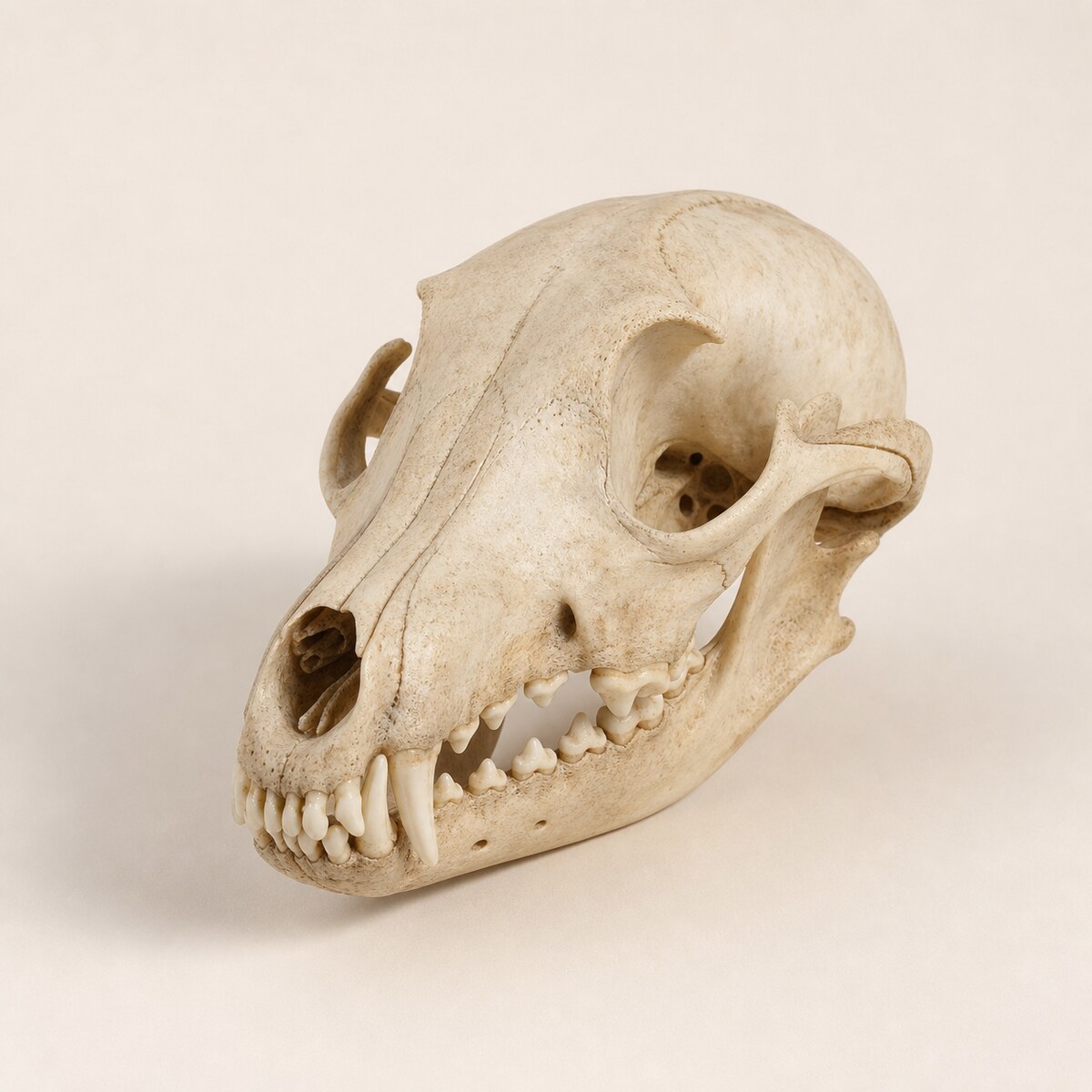
Teeth are among the most informative features. Look at the front teeth, the canines (the long, pointed teeth behind them), and the cheek teeth further back. Sharp, blade-like cheek teeth and long canines lean toward meat-eaters; broad, flat grinding teeth lean toward plant-eaters; and large chisel-like front teeth suggest gnawing animals such as rodents and rabbits. Empty tooth sockets still show where teeth once sat, which helps when some are missing.
Other features refine the match. The snout may be long or short; the eye socket, or orbit, may be open at the back or closed off by a thin bar of bone; and the palate, the roof of the mouth on the underside, along with ridges (crests), small pits, and bony bumps (processes), all narrow the options. Each term simply names a place to look, so a helpful result pairs the word with what it saw. No single feature decides an identification on its own; the reliable approach is to read several of them together.
Compare Common Skull Look-Alikes
Many skull mix-ups come down to one or two features, so a good skull identification names the trait that separates each pair rather than guessing from overall shape. Rodents and rabbits both have prominent gnawing front teeth, but rabbits and hares carry a small second pair of peg teeth directly behind the large upper front teeth, while rodents have a single pair. Among meat-eaters, cats tend to have short, rounded skulls with few cheek teeth, dogs and foxes have longer snouts with more teeth, and raccoons and their relatives fall in between, so a clear tooth count and profile view matters.
Hoofed animals such as deer add their own cues, including a gap where canines would be and, in some, small pits in front of the eyes. Bird skulls are often separated less by the braincase than by beak shape and size, which track feeding style. Domestic animals complicate all of this: a dog, cat, sheep, goat, pig, or cow skull can turn up far from a farm, and an escaped, released, or traded exotic animal can appear well outside its native range.
Imperfect specimens are the norm rather than the exception. Juvenile skulls have different proportions and unfused seams and can resemble a different species. Missing teeth, an absent lower jaw, cracks, and weathering all remove information, and the camera angle itself can distort proportions. This is why size alone or a passing resemblance alone is rarely enough, and why adding more angles and context usually does more for the result than one striking photo.
Verify the Result and Handle Finds Responsibly
A skull identifier gives you an AI-assisted best match, and the last step is to treat it that way. The result names a likely animal, lays out the evidence for and against it, and offers alternatives so you can compare rather than accept a single label. For anything that matters, such as a classroom specimen, a collection record, or a find that raises questions, confirm it against a reputable regional key, a museum or reference collection, or a qualified expert. It is not a forensic finding, a diagnosis, an appraisal, or proof that a specimen is legal to keep.
Location is context, not proof. Where a skull was found shifts which animals are plausible, but it never settles identity on its own, because animals are moved, escape, and are traded far from home. Use geography to weigh the options, and let the visible features carry the identification.
Handle finds carefully and lawfully. If there is any real chance the remains could be human, stop: this tool cannot rule that in or out, so leave the specimen undisturbed and contact your local authorities. For animal remains, rules on collecting, keeping, transporting, and selling vary by country, region, and species, and some birds and protected animals have specific restrictions, so check what applies where you are and get landowner permission before keeping anything. Photograph a skull as you found it before any cleaning; if it needs it, a gentle brush or a light rinse of a small area is plenty, while harsh methods such as boiling or bleaching can damage bone and are best left to people with the right experience.
Put what you’ve learned to use
Upload your photos and compare the suggested match with the features you observed.
Frequently Asked Questions
What is a skull identifier?
A skull identifier is an online tool that helps you identify an animal skull from photos. It reviews visible features such as overall size, the shape and type of teeth, the snout or beak, the eye sockets, the palate, and the lower jaw, then suggests a likely animal and explains the clues behind the match. The result is an AI-assisted best match, not a confirmed identity.
Is the skull identifier free to use?
Yes. You can upload skull photos and receive an AI-assisted result for free, with a generous daily allowance of identifications and no sign-up required. It is useful for hikers, students, collectors, teachers, families, and anyone curious about a skull they found. For unlimited identifications, unlimited AI chat, and saved collections, you can upgrade to IdentifyRock Unlimited.
Do I need to sign up before using the skull identifier?
No. You do not need to create an account, enter a password, or complete a registration form. Open the online tool, upload a clear skull photo, add optional location and notes, and view your result.
Do I need to download an app to identify a skull?
No. The skull identifier works online in your browser, so there is no app to download. You can use it from a phone, tablet, laptop, or desktop as long as you have a photo and an internet connection.
What photos give the best skull identification?
Use several sharp, well-lit photos rather than one. A full view, a side profile, a top-down view, the underside or palate, a close-up of the teeth, and the lower jaw together show far more than a single angle. Include a coin or ruler for scale in at least one shot, since size is a useful clue only when the scale is clear. Details such as tooth shape and whether the eye socket is closed at the back are often what separate similar skulls.
Can the tool tell me which animal the skull is from?
It can often suggest a broad group, such as a rodent, a carnivore, a deer, or a bird, and sometimes a more specific animal when the photos show enough detail. A single weathered or partial skull may only support a general group. Clear teeth, jaw, and profile views make a narrower match more likely.
How does it tell a mammal skull from a bird or reptile skull?
The tool weighs features that tend to separate these groups. Bird skulls usually have a beak, very large eye sockets, and no teeth; most mammal skulls have specialized teeth doing different jobs and a separate lower jaw; many reptile and amphibian skulls look flatter with rows of similar small teeth. These are tendencies rather than guarantees, so the result explains the features it saw.
What can a skull's teeth tell me?
Tooth shape is strong supporting evidence for an animal's diet and group. Long stabbing canines and blade-like cheek teeth point toward meat-eaters, broad flat molars toward plant-eaters, and prominent front gnawing teeth toward rodents and rabbits. This is morphological evidence rather than proof, and missing teeth can change the picture, so it is weighed alongside the other features rather than used alone.
How do I tell a rodent skull from a rabbit or hare skull?
Both have prominent front gnawing teeth, which is why they are often confused. A common difference is that rabbits and hares have a small second pair of peg-like teeth tucked directly behind the large upper front teeth, while rodents have a single pair. The identifier looks for cues like this, so a clear, straight-on photo of the front teeth helps a lot.
Can it identify a skull with missing teeth or no lower jaw?
Often yes, at least to a broad group. Partial skulls, isolated jaws, missing teeth, and weathering all remove information, so the match may stay general and the confidence lower. Photograph whatever remains clearly, note what is missing, and add any loose teeth or jaw pieces you found with it.
What should I do if the skull might be human?
Stop and treat it seriously. This tool cannot rule human remains in or out, and it is not a forensic service. If there is any real chance the skull is human, do not disturb it further and contact your local law-enforcement or other appropriate authorities so the site can be handled properly.
Is it legal to keep a skull I found?
It depends. Rules on collecting, keeping, transporting, and selling animal remains vary by country, region, and species, and some birds, marine mammals, and protected or endangered animals carry specific restrictions. Check the rules that apply where you are, and get landowner permission, before keeping a find. This tool does not confirm that a specimen is lawful to possess.
How accurate is the skull identifier, and should I clean the skull first?
Treat the result as a strong starting point rather than a final answer. No photo-based tool can guarantee the right species every time, especially for worn, juvenile, or lookalike skulls, so verify important identifications with a regional key, a museum collection, or a qualified expert. Photograph the skull as you found it first; if it is caked in dirt, a gentle brush or a light rinse of a small area is enough, and it is best to avoid boiling, bleaching, or other harsh cleaning that can damage bone.
Ready to give it a try?
Upload your photos for an AI-assisted best match.