Ruby Identifier
Instant, accurate gemstone identification powered by artificial intelligence
Identification form
Upload ruby photos
Clear, well-lit images help the AI identify it more accurately.
Unlock Unlimited Access
- Unlimited Identifications
- Unlimited AI Chat Messages
- Save and Organize Your Collection
How to Identify a Ruby by Photo
- 1
Snap a Clear Photo
Click "Upload Images" to select a photo. For the most accurate ruby identification, ensure the gemstone is well-lit (natural daylight is best) and cleaned of any fingerprints or dust.
- 2
Capture Details & Angles
Upload extra photos to help the AI. Macro shots showing internal inclusions, the cut of the facets, or the stone from the side profile provide vital clues. Tip: Avoiding glare helps the system see the true color.
- 3
Provide the Location
If you know the origin, tell us where the ruby was acquired. Origin is a key factor in gemology—a stone from Burma (Myanmar) may have different visual characteristics than one from Mozambique.
- 4
Add Observations
Input specific traits to narrow down the results. Note the transparency (is it clear or cloudy?), shape, and if it fluoresces (glows) under UV light, which is common for genuine rubies.
- 5
Get Instant Results
Click "Identify Ruby" to start the analysis. Our tool will compare your photos against thousands of gemstone samples to provide the closest matches and authenticity likelihood.
Ready to identify it?
Upload one or more clear photos to get started.
What Defines a Genuine Ruby?
Rubies are among the most coveted gemstones in the world, renowned for their intense red hue and historical significance. A member of the corundum mineral family, a ruby derives its vibrant color from traces of chromium. Without this specific element, the stone would simply be a sapphire. Distinguishing a genuine gemstone from look-alikes such as spinel, garnet, or red tourmaline can be challenging for the untrained eye. This is where modern technology assists enthusiasts and collectors. By analyzing optical properties captured in images, we can estimate the likelihood of a stone being a true ruby.
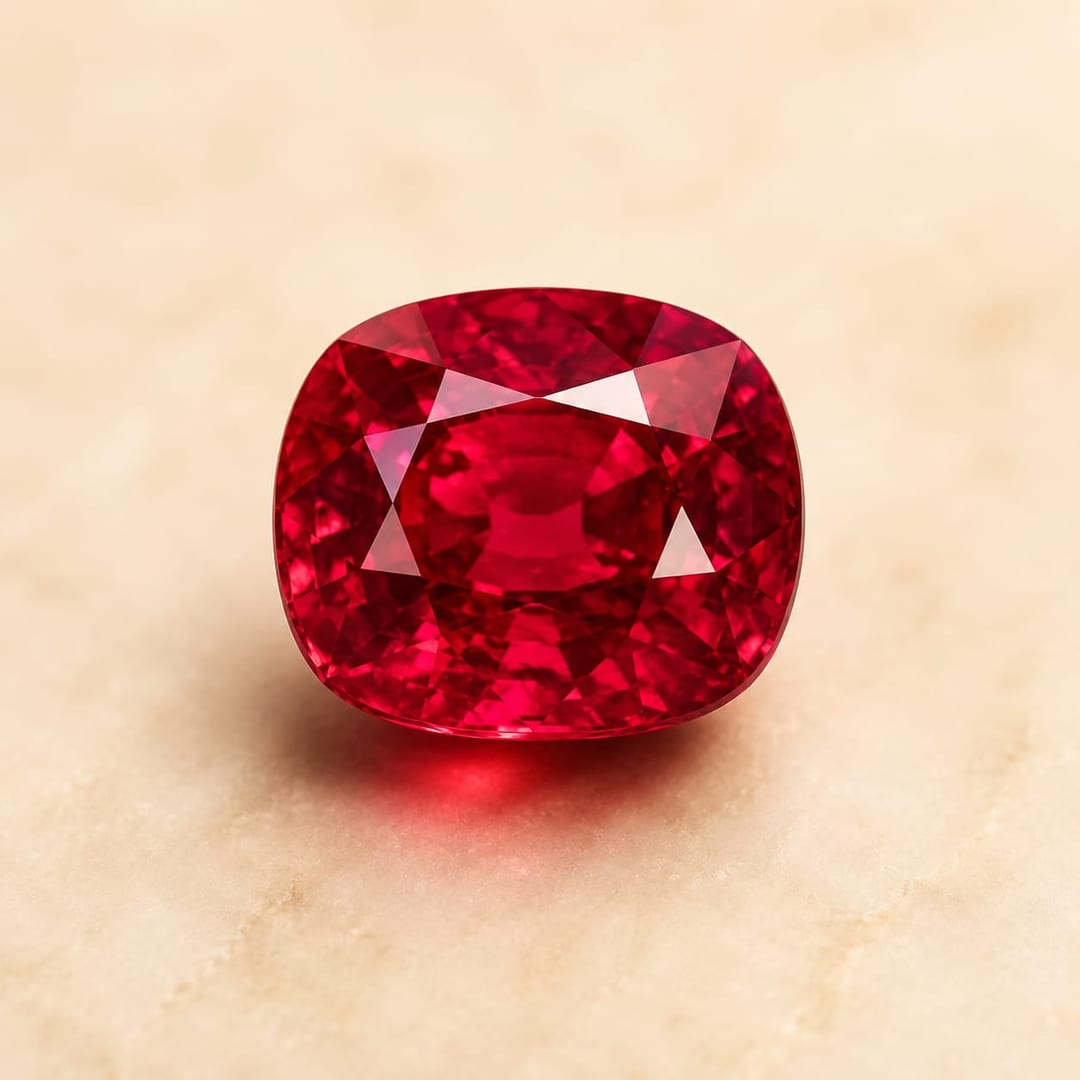
The primary factor in classification is color, specifically the intensity and saturation of red. The most prized shade is often referred to as Pigeon Blood, a deep, vibrant red with a hint of blue. Clarity also plays a massive role; unlike diamonds, natural rubies almost always possess internal imperfections. These internal features, often called inclusions, act as a fingerprint for the gem, proving its natural origin versus a lab-grown counterpart. Understanding these fundamental traits is the first step in successful analysis.
Key Visual Characteristics
When assessing a gemstone, physical durability is a key indicator. Rubies rank 9 on the Mohs scale of hardness, second only to diamonds. This extreme hardness means that a natural ruby should be relatively free of scratches compared to softer red stones like glass or garnet. When viewing your specimen through our digital system, sharp facet edges and a lack of surface abrasion are positive signs. Furthermore, the way the crystal interacts with light, known as its refractive index, creates a distinct brilliance that softer imitations struggle to replicate.
Another fascinating property is fluorescence. Many high-quality rubies, particularly those from specific geological deposits like Myanmar, glow with a strong red intensity when exposed to ultraviolet light. This occurs because the chromium content reacts to UV waves. While our web interface relies on standard photography, knowing these physical behaviors helps users capture better images. If you can photograph your stone under different lighting conditions, it provides the algorithm with more data points to distinguish the specific optical signature of corundum from other red minerals.
Differentiating Real from Fake
One of the most critical aspects of gemology is separating natural earth-mined stones from synthetics and simulants. Synthetic rubies are chemically identical to natural ones but are created in a laboratory. They often display curved growth lines or gas bubbles that are not present in nature. Simulants, on the other hand, are different materials entirely, such as colored glass or composite doublets, which merely mimic the appearance of the gem. High-resolution photos can sometimes reveal tell-tale signs, such as the silk (fine rutile needles) often found in natural stones, versus the perfect, clean structure of a flame-fusion synthetic.
Our system analyzes the texture and internal visual patterns to flag potential synthetics. While a photograph cannot replace a microscopic inspection by a certified gemologist, it serves as a powerful initial screening filter. Users should pay close attention to the uniformity of color; natural stones often show zoning or slight variations, whereas glass or cheap synthetics might look unnaturally consistent. Detecting these subtle nuances is how digital analysis brings professional-grade scrutiny to your smartphone or computer screen.
Digital Gemology and AI
The evolution of computer vision has revolutionized how we interact with the mineral kingdom. By leveraging vast databases of geological samples, our platform offers a convenient way to check your findings without the need for expensive equipment. This service is designed to be accessible to everyone, from rockhounds hiking in the field to jewelry buyers browsing estate sales. The ability to perform a quick check can prevent costly mistakes and spark a deeper interest in mineralogy.
It is important to remember that while algorithms are powerful, they work best when provided with high-quality input. A blurry image or poor lighting can obscure the necessary details for a confident match. Therefore, we encourage users to take their time setting up the shot. Use a macro lens if available, or simply ensure the camera focuses squarely on the gem. This synergy between human preparation and machine learning creates the most effective results, bridging the gap between casual curiosity and scientific verification.
Put what you’ve learned to use
Upload your photos and compare the suggested match with the features you observed.
Frequently Asked Questions
How does the ruby identifier work?
Our system uses advanced Artificial Intelligence trained on thousands of gemstone images. It analyzes the color, cut, refractive properties, and visible internal inclusions in your photo to determine if the stone is likely a ruby or a look-alike.
Is this ruby identification tool free?
Yes, the ruby identifier is free to use, with a generous daily allowance of identifications and no sign-up required. For unlimited identifications, unlimited AI chat, and saved collections, you can upgrade to IdentifyRock Unlimited.
Do I need to download an app?
No, this is a web-based application. You can use it directly in your browser on any device without downloading or installing any software.
Is accurate is the identification?
The AI is highly accurate at distinguishing rubies from distinct minerals like quartz or glass. However, distinguishing between high-quality synthetic rubies and natural ones can be difficult visually. It serves as an excellent initial screening tool.
Do I need to sign up to use the tool?
No, we do not require any registration or account creation. You can start identifying gemstones immediately and anonymously.
Can it identify rubies set in jewelry?
Yes, the tool can analyze stones set in rings, necklaces, or earrings. Try to take photos from multiple angles to show as much of the stone as possible, avoiding the metal setting where you can.
Can it distinguish a ruby from a garnet or spinel?
Yes, rubies, garnets, and spinels have different optical properties and color hues. Our AI looks for specific shades of red and light reflection patterns that differentiate corundum (ruby) from these other minerals.
Is there a limit to how many photos I can upload?
The free version includes a generous daily allowance of identifications, and each identification can include multiple photos. To review an entire collection without a daily cap, plus unlimited AI chat and saved collections, you can upgrade to IdentifyRock Unlimited.
Can this tool tell me the value of my ruby?
This tool focuses on identification and classification. While identifying a stone as a genuine ruby implies value, we do not provide monetary appraisals, as value depends heavily on carat weight, clarity, and market conditions.
Does it detect synthetic or lab-grown rubies?
The AI attempts to detect signs of synthetic growth, such as curved striae or gas bubbles, if they are visible in the photo. However, some synthetics are chemically identical to natural stones and may require microscopic lab analysis for confirmation.
What is the best lighting for identifying a ruby?
Natural, diffused daylight is best. Avoid harsh flash photography which can cause white glare spots that obscure the color and internal details of the gem.
Can I use this on my mobile phone?
Absolutely. The website is fully optimized for mobile devices, allowing you to snap a photo and upload it instantly from your phone.
Ready to give it a try?
Upload your photos for an AI-assisted best match.