Gold Hallmark Identifier Online Free
Upload photos of the stamps on your gold and decode purity numbers, symbols, and maker initials with a free AI tool
Identification form
Upload gold hallmark photos
Clear, well-lit images help the AI identify it more accurately.
Unlock Unlimited Access
- Unlimited Identifications
- Unlimited AI Chat Messages
- Save and Organize Your Collection
How to Use the Gold Hallmark Identifier
- 1
Find Every Mark on the Item
Check the inner band of rings, the clasp and end tags of chains, watch case backs, pendant bails, earring posts, and each separate component. Handle the piece gently and do not polish, scrape, or deep-clean the marked area — polishing can blur the very details that identify a hallmark.
- 2
Photograph the Whole Item First
Take one photo that shows the complete piece. Whether it is a ring, chain, bracelet, watch case, brooch, or coin-like article changes which marks are plausible, and construction details such as solder joints, hinges, and clasp style add useful context to the reading.
- 3
Capture Sharp Close-Ups of the Marks
Move in with steady macro focus and bright, diffuse light angled low across the surface so shadows fill the punched lines. Photograph the full row of stamps in one frame plus each mark separately, keep the border or cartouche shape visible, and avoid filters that alter color.
- 4
Add What You Know
Enter where the item was bought, found, or inherited, and add notes such as the object type, characters you can already read by eye, the number and order of the stamps, and any repairs or resizing. Context like this helps narrow the likely jurisdiction and era.
- 5
Get Your Hallmark Reading
Click "Identify gold hallmark" to start. The tool compares your photos and notes with common marking systems, then returns the closest reading, the clues that support it, and what a stamp alone cannot prove. Treat the result as a researched lead, not a verdict.
Ready to identify it?
Upload one or more clear photos to get started.
Read the Whole Mark Cluster, Not One Stamp
The most common mistake in gold hallmark identification is reading one stamp in isolation. A full hallmark is a small system of marks, and each plays a different role: a fineness or standard mark states the declared purity, a maker's or sponsor's mark identifies who submitted the piece, an assay office mark shows where it was tested, a date letter records an assay period in systems that use one, and import or convention marks can appear on articles that crossed borders.
Because the marks work together, the details around them are evidence too. The order of the stamps, the shape of each border or cartouche, the typeface and case of letters, and the spacing between punches all help separate one marking system from another. Two stamps with the same letters can mean different things inside different shield shapes, which is why a gold hallmark identifier that sees the entire row in one photo has more to work with than a lookup of any single symbol.
The cluster should also agree with itself and with the object. A purity number that does not exist in the suggested system, a date letter style that clashes with the office symbol beside it, or a pristine mark on a heavily worn band are all signals worth attention. When you upload photos, include every stamp you can find — even ones that look redundant — plus the whole item, so the reading can weigh the marks as a set rather than guessing from a fragment.
Gold Purity Numbers and Karat Equivalents
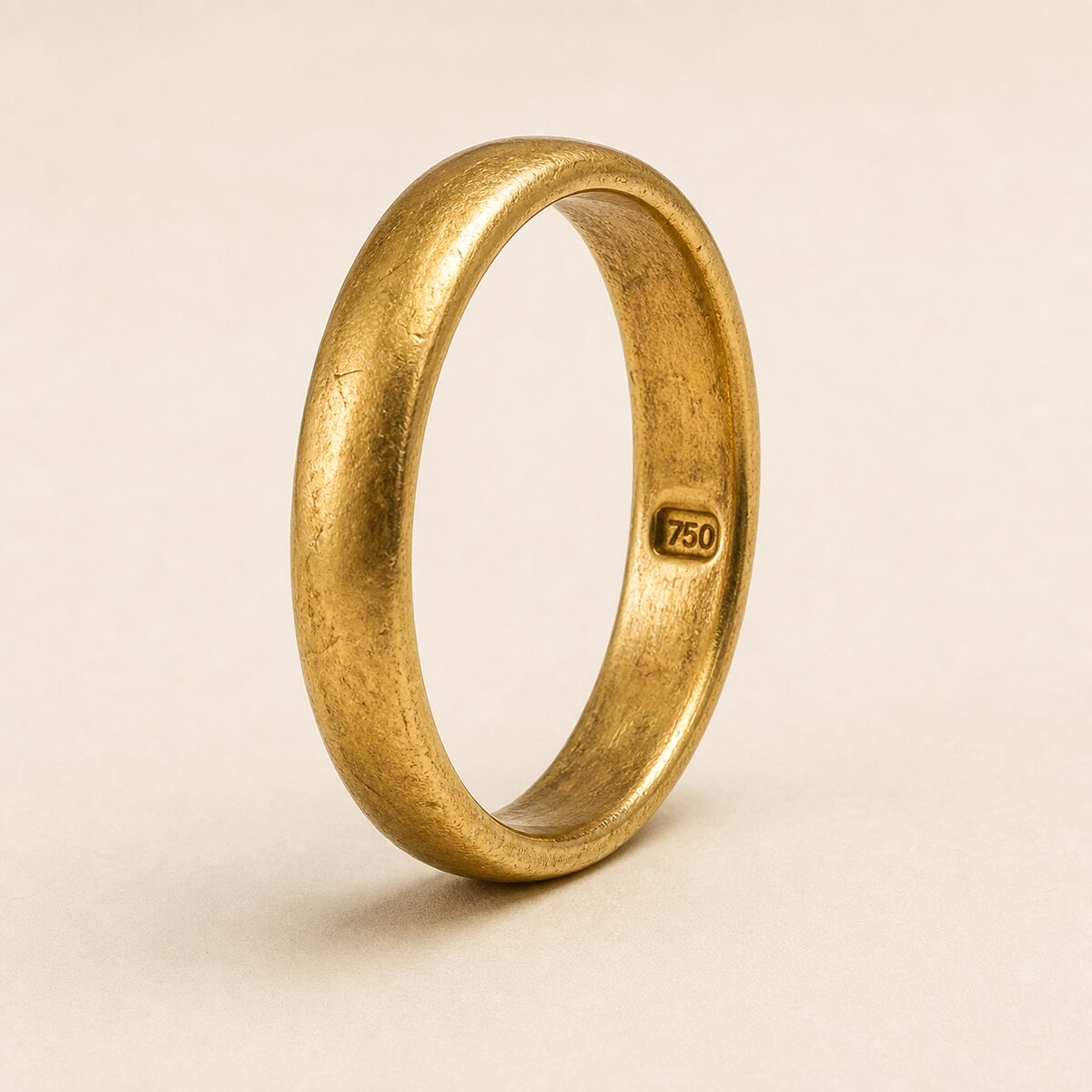
Most gold purity stamps use one of two systems. Karat (marked K, KT, or ct in some countries) counts parts of gold out of 24, so 24K describes essentially pure gold. Millesimal fineness counts parts per thousand. The well-supported everyday conversions are: 375 = 9K, 417 = 10K, 585 = 14K, 750 = 18K, 916 = 22K, and 999 = 24K. A ring stamped 750 and a ring stamped 18K are declaring the same standard in two notations.
The number needs context before it means anything. The same millesimal scale covers other precious metals — 925 is the familiar sterling silver standard, and platinum has its own common values — so a three-digit number on a white metal is not automatically a gold mark. Color does not change the numbering either: yellow, white, and rose gold of the same standard carry the same fineness mark, because the stamp describes gold content, not hue.
Higher numbers mean more gold, which also tends to mean a softer, deeper-colored alloy; lower-karat alloys trade gold content for hardness and wear resistance. That tradeoff explains why everyday jewelry clusters around the middle values while some traditions favor 22K and above.
One caution above all: a purity stamp is a declaration, not a measurement you have witnessed. The identifier can tell you what the number claims and whether it fits the rest of the mark cluster, but only a professional test of the metal itself can confirm that the alloy matches the stamp.
UK Hallmarks, US Karat Stamps, and Other Regional Systems
Marking traditions differ sharply by jurisdiction, and knowing which system you are looking at is half the identification. British hallmarks are the most structured you are likely to meet: an official multi-mark set that combines a sponsor's mark, a millesimal fineness mark, and an assay office symbol — for example, an anchor for Birmingham or a leopard's head for London — often joined by a date letter. The parts are designed to be read together, and the office symbol tells you which office's date-letter charts even apply.
United States practice looks different. Instead of an official office stamp, you typically find a karat mark such as 10K or 14K accompanied by a manufacturer's registered trademark, so a US piece can be perfectly legitimate while carrying far fewer marks than a British one. Much of continental Europe uses small pictorial punches whose meaning depends on country, metal, and period, and internationally traded pieces may add convention or import marks on top.
This variety is why symbol shortcuts fail. A tiny emblem can resemble another country's punch, meanings shift across decades, and worn punches lose exactly the details that distinguish them. The identifier approaches the problem the way a careful reference does: it weighs the whole cluster, the object type, and the origin context you provide, then names the most plausible system along with its confidence — instead of forcing your marks into one country's chart. Adding where the piece was bought or inherited, even loosely, meaningfully narrows the options.
Plated, Filled, Worn, and Suspicious Marks
Not every gold-colored article carrying a mark is solid gold, and the qualifiers matter. Plated and electroplated pieces (GP, GEP, or HGE for heavier electroplate) carry a thin surface layer of gold over another metal. Gold-filled (GF) and rolled gold plate (RGP) constructions bond a thicker gold layer to a base metal, and gold-filled marks often state the proportion as a fraction. These are distinct constructions with different durability and different metal content — flattening them all into "fake" or all into "plated" loses information a buyer or seller genuinely needs.
Missing marks deserve the same nuance. Rules about what must be marked vary by country, era, and article weight; handmade and antique pieces may predate or escape marking requirements; and resizing, repair, engraving, or long wear can remove a stamp that was once there. Mixed results are normal too: clasps, springs, pins, and solder are often different alloys from the main body, so one component testing or reading differently does not condemn the whole piece.
Suspicious signals exist, and the identifier will name them when visible: a crisp, fresh-looking punch on an otherwise heavily worn surface, mark roles that do not belong together, lettering in the wrong style for the claimed system, or a purity value that no real standard uses. But surface appearance is never a material test. Color, shine, and even weight can be imitated, so treat visual red flags — and visual reassurances — as reasons to verify, not conclusions.
From a Likely Reading to Confirmation and Value
A photo-based reading is the beginning of hallmark research, not the end, and it helps to keep the underlying questions separate. What the marks claim is one question. What the metal actually is, when and where the piece was assayed, who made it, and what it is worth are four more — and each is settled by different evidence.
A sensible escalation ladder looks like this. First, improve the evidence for free: better-lit macro photos, every component checked for marks, and notes about provenance. Next, compare the suggested reading against official references — assay office publications and registered maker databases are the authorities for their own marks. When money, insurance, or a dispute depends on the answer, move to people and instruments: a qualified jeweler or appraiser can examine the piece directly, and non-destructive analysis such as XRF can test the metal without damaging it. Skip casual home acid testing; it can scar the piece and still mislead.
Value deserves particular care, because a stamp cannot supply it. Melt value depends on verified fineness and the actual gold weight once stones, solder, springs, and fittings are excluded, priced against a live spot market. Resale, auction, and insurance values layer condition, maker, rarity, and demand on top, and the figures can differ widely for the same object. This gold hallmark identifier will tell you what the visible marks most plausibly say, what would strengthen or weaken that reading, and which expert to ask next — a scope that keeps the result honest and genuinely useful.
Put what you’ve learned to use
Upload your photos and compare the suggested match with the features you observed.
Frequently Asked Questions
What is a gold hallmark identifier?
A gold hallmark identifier is an online tool that helps decode the tiny stamps on gold jewelry and other gold articles from photos. It reviews the visible mark cluster — purity numbers, symbols, initials, and the shapes around them — and returns an AI-assisted reading that explains what each stamp most likely represents and how much certainty the photos support.
Is the gold hallmark identifier free to use?
Yes. You can upload photos of your marks and receive an AI-assisted reading for free, with a generous daily allowance of identifications and no sign-up required. For unlimited identifications, unlimited AI chat, and saved collections, you can upgrade to IdentifyRock Unlimited.
Do I need to sign up or download an app?
No. The tool works online in your browser on a phone, tablet, laptop, or desktop, so there is no app download, no account, and no registration form. Upload your photos, add optional notes, and view your result.
What do numbers like 375, 585, and 750 mean on gold?
They are millesimal fineness marks, which state precious-metal content in parts per thousand. Common gold values are 375 (9K), 417 (10K), 585 (14K), 750 (18K), 916 (22K), and 999 (24K). Other metals use the same numbering — 925 is a standard silver fineness, for example — so a number alone does not tell you which metal was stamped.
Is 585 the same as 14K gold?
In practice, yes. Karat counts parts of gold out of 24, so 14K is about 58.3% gold, and a 585 stamp declares 58.5 parts per thousand — the two marks describe essentially the same alloy standard, written in different systems. Either stamp is still a claim about the metal, not proof of it.
Does a hallmark prove my item is real gold?
No. A hallmark is strong evidence, not proof. Stamps can be forged, transferred from another piece, worn into ambiguity, or applied to plated items, and honest articles can carry unfamiliar marks. Weigh any mark alongside the item's construction and wear, and rely on professional testing when the answer matters financially.
What do GP, GEP, HGE, GF, and RGP mean?
They all signal that an item is not solid gold of the stamped karat, but they describe different constructions. GP and GEP indicate gold plating or electroplating, HGE is heavy gold electroplate, RGP is rolled gold plate, and GF marks gold-filled pieces, which carry a thicker bonded gold layer often stated as a fraction such as 1/20 14K GF. The identifier points out these qualifiers when they are visible.
Why does my gold item have no hallmark at all?
There are legitimate reasons. Marking rules differ by country and era, some jurisdictions have exempted small or lightweight articles, older or handmade pieces may never have been marked, and resizing, repair, or decades of wear can remove a stamp. A missing mark lowers certainty but does not prove an item is fake — just as a present mark does not prove it is genuine.
Where should I look for hallmarks on gold jewelry?
Check the inside of ring bands; the clasp, jump ring, or end tags of chains and bracelets; the backs and bails of pendants; earring posts; brooch pin assemblies; and watch case backs and inner surfaces. Multi-part items are often marked on more than one component, and different components can legitimately carry different marks.
How do I photograph a tiny or worn hallmark?
Use your camera's macro or zoom mode, brace your hands, and light the mark from a low angle so shadows fill the punched lines. Take several shots from different directions, include the whole row of stamps plus each mark close up, and skip filters. If a character is clearer to your eye than to the camera, type it into the notes.
Can a date letter tell me exactly when my item was made?
It can suggest a period, with caveats. In systems that use date letters, the letter records when the article was assayed, which is not always the year it was made, and the same letter repeats across cycles. Reading one reliably requires the assay office, the letter's typeface and case, and the shield shape around it, so expect a date range rather than an exact year.
Can the identifier tell me who made my jewelry?
It can point out which stamp is likely a maker's or sponsor's mark and suggest research directions, but initials are not unique and registries are jurisdiction-specific. Treat any maker suggestion as a lead to check against a registered maker database or specialist reference, not as an attribution.
Can this tool tell me what my gold is worth?
No. The result is not an appraisal or a value guarantee. Value depends on verified fineness, the actual gold weight excluding stones and non-gold parts, the live spot price, condition, maker, and rarity — and melt, resale, auction, and insurance values are different figures. Use the reading to prepare better questions for a qualified appraiser.
Ready to give it a try?
Upload your photos for an AI-assisted best match.