Diamond Identifier
Instantly verify the authenticity of your gemstones with our precision AI identification technology.
Identification form
Upload diamond photos
Clear, well-lit images help the AI identify it more accurately.
Unlock Unlimited Access
- Unlimited Identifications
- Unlimited AI Chat Messages
- Save and Organize Your Collection
How to Use the Diamond Identifier
- 1
Snap a Clear Photo
Click "Upload Images" to select a photo of your gemstone. For the most accurate diamond identification, ensure the stone is cleaned of fingerprints and placed under bright, neutral lighting (avoid yellow indoor bulbs). A macro shot works best.
- 2
Capture Details & Angles
Upload multiple images to help the AI analyze light performance. Capture the table (top view) to show symmetry, and side views to reveal the pavilion and girdle. Focus on facet edges—sharpness often distinguishes real gems from glass.
- 3
Provide the Context
Tell us about the item. Is it a loose stone or set in jewelry? If set, look for stamps on the metal (like 14K or PT950). High-quality metal settings are a positive indicator for genuine stones.
- 4
Add Observations
Input specific visual traits. Note if the stone reflects rainbow colors (fire) or mostly white light (brilliance). Mention if you notice any black spots (inclusions) or if the stone looks perfectly clear.
- 5
Get Instant Results
Click "Identify Diamond" to start the analysis. Our tool will compare the refractive patterns and visual signature of your photo against a database of genuine diamonds and common simulants like Cubic Zirconia.
Ready to identify it?
Upload one or more clear photos to get started.
The Science Behind Digital Gemstone Analysis
Digital gemstone analysis represents a leap forward in how we verify precious stones. Traditionally, distinguishing a genuine stone from a simulant required physical tools like thermal probes, loupes, or specific gravity balances. However, recent advancements in computer vision allow us to analyze the unique optical properties of a gem through imagery alone. A genuine diamond interacts with light in a very specific way, known as its refractive index. When light enters the stone, it bends and reflects internally to create the sparkle we see.
Our technology examines the pattern of light and dark areas within the stone, known as scintillation. It also scrutinizes the facet junctions. Because diamonds are the hardest known natural material, scoring a 10 on the Mohs scale, their facet edges are incredibly sharp and crisp. Softer materials like glass or plastic will often show rounded, molded, or abraded edges. By processing these minute visual cues, the algorithm can calculate the likelihood of the stone being carbon-based versus a softer imitation, providing a rapid assessment without the need for expensive hardware.
Distinguishing Diamonds from Common Simulants
One of the primary challenges in gemology is separating real stones from convincing look-alikes, known as simulants. The most common simulants include Cubic Zirconia (CZ), Moissanite, and high-lead glass. Each of these materials has a tell-tale visual signature that AI can learn to spot. For instance, CZ is optically flawless and often completely colorless, which can ironically make it look "too perfect" compared to a natural stone that might have slight imperfections or color tint. Furthermore, CZ has a lower refractive index but higher dispersion, meaning it throws more rainbow-colored sparkles than a real diamond, which balances white light (brilliance) with colored light (fire).
Moissanite presents a different challenge because it is also very hard and conducts heat similarly to a diamond. However, it is doubly refractive. If you look closely at the facets of a Moissanite, they may appear doubled or blurry, similar to seeing double vision. A diamond is singly refractive, meaning light passes through it as a single beam. Advanced visual analysis detects these subtle blurring effects on the facet lines, helping to flag Moissanite even when it passes basic thermal tests. Understanding these optical differences is key to accurate verification.
Key Visual Characteristics of Genuine Diamonds
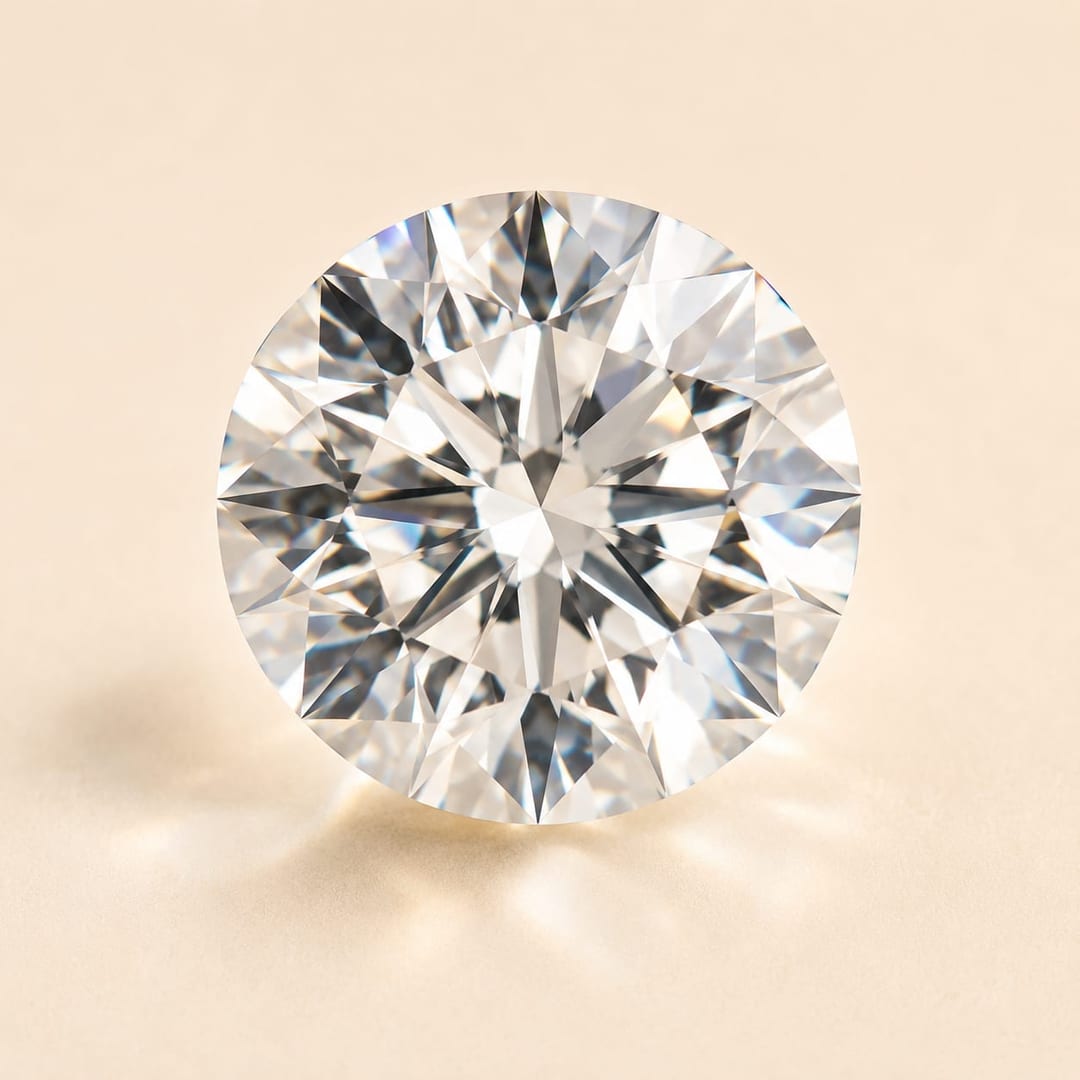
When analyzing a stone, several visual characteristics serve as strong indicators of authenticity. The first is luster. A diamond exhibits what is called adamantine luster, a unique, somewhat greasy shine that differs from the vitreous (glass-like) luster of quartz or the metallic luster of hematite. This surface quality is particularly visible on the unpolished parts of the stone, such as the girdle (the edge separating the top and bottom).
Another critical visual trait is transparency and the read-through effect. Because of the intense light leakage and high refraction in a poorly cut simulants, you might be able to read text through them. Conversely, a well-cut diamond bends light so sharply that if you place it face down on a newspaper, you usually cannot read the print through it. Furthermore, inclusions—tiny internal flaws—are actually a good sign. Most natural stones contain small crystals, feathers, or clouds. While we generally want clear stones, the presence of specific natural inclusions confirms that the stone was formed deep within the Earth rather than in a factory lab. Our system scans for these natural "birthmarks" to assist in the verification process.
When to Consult a Professional Gemologist
While digital screening is a powerful resource for immediate insight, it serves as a first step rather than a final verdict. The world of gemology is vast, and synthetic diamonds (lab-grown) share the exact same chemical and physical properties as mined diamonds. Because lab-grown stones are chemically identical to natural ones, distinguishing them often requires specialized equipment like UV fluorescence spectroscopy or cathode-luminescence machines found only in professional laboratories.
For stones of significant value, or when you are planning to sell or insure an item, we always recommend consulting a certified gemologist or an appraisal service. Organizations like the GIA (Gemological Institute of America) or AGS (American Gem Society) provide grading reports that verify not just the authenticity, but also the quality of the stone based on the 4Cs: Cut, Color, Clarity, and Carat weight. Our online solution is perfect for filtering out obvious fakes like glass or CZ from your jewelry box, but a physical certificate is the gold standard for high-value commerce and insurance purposes.
Put what you’ve learned to use
Upload your photos and compare the suggested match with the features you observed.
Frequently Asked Questions
Is this diamond identifier free to use?
Yes, the diamond identifier is free to use, with a generous daily allowance of identifications and no sign-up required. For unlimited identifications, unlimited AI chat, and saved collections, you can upgrade to IdentifyRock Unlimited.
Do I need to download an app to use this tool?
No, there is no need to download or install anything. This is a web-based application that works directly in your browser on both mobile and desktop devices.
How does the AI identify diamonds from photos?
Our system uses advanced machine learning trained on thousands of images of real diamonds and simulants. It analyzes visual properties such as light reflection, facet precision, and cut symmetry to determine probability.
Is there a limit to how many diamonds I can identify?
The free version includes a generous daily allowance of identifications, enough for most jewelry collections. To check stones without a daily cap, plus unlimited AI chat and saved collections, you can upgrade to IdentifyRock Unlimited.
Do I need to sign up or create an account?
No registration is required. We prioritize ease of use and privacy, so you can start identifying immediately without sharing your email or personal details.
Can this tool distinguish between a diamond and Cubic Zirconia (CZ)?
Yes, the AI is trained to spot the differences. Cubic Zirconia often displays excessive 'fire' (rainbow flashes) and has rounded facet edges compared to the sharp edges and balanced brilliance of a genuine diamond.
Does it work on raw, uncut diamonds?
Yes, but it may be slightly less accurate than with cut stones. For raw diamonds, the AI looks for the characteristic octahedral crystal shape and greasy luster typical of unpolished diamond rough.
Can the tool detect Moissanite?
Moissanite is a difficult simulant because it tests as a diamond on thermal testers. However, our visual AI looks for 'double refraction' (blurring of facet lines), which is a key trait of Moissanite but not diamond.
Is this tool a substitute for a professional appraisal?
While highly accurate for screening, no photo-based analysis can replace a physical inspection by a certified gemologist. We recommend this for initial checking, but use a professional for insurance valuations.
How accurate is the identification?
The accuracy relies heavily on photo quality. With clear, high-resolution macro photos, the success rate is high. Blurry or poorly lit photos makes it harder for the algorithms to analyze light behavior.
Does the tool store my photos?
We process images for analysis purposes, but we prioritize user privacy. We do not use your personal uploads to display publicly without consent.
Can it tell me the value or grade (4Cs) of the diamond?
The tool focuses on verifying authenticity (real vs. fake). It does not provide a monetary value or a specific grade for Cut, Color, Clarity, and Carat, which requires microscopic lab equipment.
Ready to give it a try?
Upload your photos for an AI-assisted best match.