Arrowhead Identifier
Instantly analyze and classify projectile points using advanced recognition technology.
Identification form
Upload arrowhead photos
Clear, well-lit images help the AI identify it more accurately.
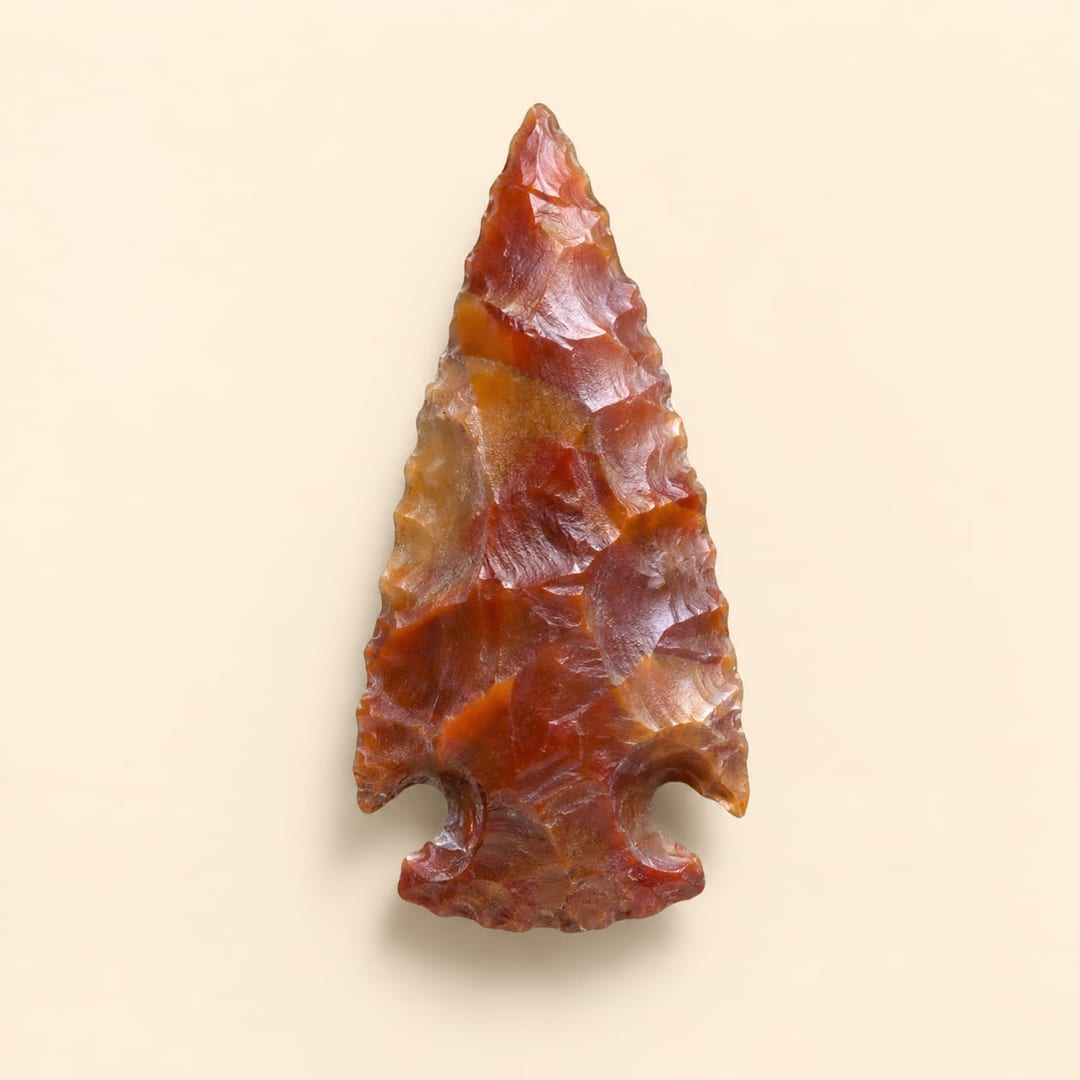
Unlock Unlimited Access
- Unlimited Identifications
- Unlimited AI Chat Messages
- Save and Organize Your Collection
How to Identify Arrowheads by Photo
- 1
Snap a Clear Photo
Click "Upload Images" to select your image. For the most accurate analysis, ensure the projectile point is well-lit (natural daylight is preferred) and placed flat on a contrasting, plain background.
- 2
Capture Details & Angles
Upload extra photos to assist the AI. Close-ups of the flaking pattern, notches, stem, and base provide vital clues. Tip: A photo showing the cross-section thickness is also helpful.
- 3
Provide the Location
Tell us where the artifact was found. Geography is a key factor—a point type found in the Great Basin is likely different from a similar-looking one found in the Ohio River Valley.
- 4
Add Observations
Input specific traits to narrow down the results. Note the material (e.g., chert, obsidian), edge treatment (serrated or smooth), and whether the base is ground or sharp.
- 5
Get Instant Results
Click "Identify Arrowhead" to start the analysis. Our technology will compare your photos against thousands of archaeological typologies to provide the closest matches.
Ready to identify it?
Upload one or more clear photos to get started.
The Basics of Projectile Point Typology
Understanding the history behind a stone artifact is the first step in successful classification. When you find what is commonly called an arrowhead, you are often holding a projectile point that could be thousands of years old. These artifacts are categorized into three main eras: Paleo-Indian, Archaic, and Woodland. Each period is defined by distinct technological changes in how stone tools were manufactured. For instance, the earliest points, such as Clovis or Folsom, are often lanceolate in shape and lack notches, featuring a unique channel or "flute" running up the center.
As time progressed into the Archaic period, the technology shifted. You begin to see the introduction of notched and stemmed bases, designed to be hafted onto spear throwers (atlatls) rather than simple hand-thrust spears. By the Woodland and Mississippian periods, the points became smaller and triangular, which are the true "arrowheads" used with a bow and arrow. Recognizing these broad categories helps narrow down the possibilities before you even begin a detailed analysis. Our platform assists in distinguishing these major temporal shifts by analyzing the silhouette and manufacturing technique visible in your upload.
Analyzing Shape and Flaking Techniques
To accurately classify a lithic artifact, one must look closely at its morphology—specifically the base, which is the most diagnostic feature. The base shape (concave, convex, or straight) and the method of hafting (side-notched, corner-notched, or stemmed) act as a fingerprint for specific cultures and time periods. For example, a point with deep corner notches and a bifurcated base might belong to the Early Archaic period, while a simple triangular point is likely from a much later era. Beyond the outline, the flaking pattern offers critical clues about the skill and method of the maker.
Knappers used various techniques, such as percussion flaking (striking with a hammerstone or antler) and pressure flaking (using a tine to push off small flakes). Some points exhibit parallel flaking, where flake scars run evenly across the face, while others show random or collateral patterns. Additionally, looking for basal grinding—the dulling of sharp edges near the base to prevent cutting the binding cord—can indicate an older age. Our system scans these intricate surface details to match your find with known archaeological examples, helping you appreciate the craftsmanship involved in creating these ancient survival implements.
Material Types and Regional Context
A crucial aspect of studying stone artifacts is understanding the raw material and the geographical context. Prehistoric people relied on high-quality stones that fractured predictably, known as cryptocrystalline quartz. Common materials include chert, flint, obsidian, quartzite, and jasper. The availability of these resources varied greatly by region, which means identifying the stone type can sometimes help pinpoint where the artifact originated or if it was traded over long distances. For example, Obsidian is common in the Western United States but rare in the East, implying long-distance trade networks if found there.
Geography is equally vital for typology. A point found in the Great Basin might look similar to one from the Southeast, but they could be separated by thousands of years and completely different cultures. This is why providing the find location is essential for a precise result. Localized variations occur frequently; a specific style might be unique to a single river valley or watershed. By combining visual data with geographic constraints, we can filter out unlikely matches, ensuring that the classification respects the regional archaeological record.
Responsible Stewardship and Documentation
While discovering ancient artifacts is exciting, it comes with a responsibility to practice ethical stewardship. Recording the provenance—the exact location where an item was found—is arguably the most important part of collecting. An artifact without context loses much of its historical value. We encourage users to keep detailed logs of their finds, including GPS coordinates, soil conditions, and associated surface features. This data converts a simple curiosity into a piece of scientific evidence that can help archaeologists understand past human behavior.
It is also critical to be aware of and respect all laws regarding artifact collection. In many places, collecting on federal or state land is strictly prohibited to preserve heritage sites. Surface hunting on private land, with the landowner's explicit permission, is generally the only legal method for amateur enthusiasts. Our platform is designed as an educational resource to foster appreciation for prehistory. We promote the idea that the best way to honor the past is to document finds responsibly and share that knowledge, ensuring these stone testaments to human ingenuity are preserved for future generations.
Put what you’ve learned to use
Upload your photos and compare the suggested match with the features you observed.
Frequently Asked Questions
Is this arrowhead identifier free to use?
Yes, the arrowhead identifier is free to use, with a generous daily allowance of identifications and no sign-up required. For unlimited identifications, unlimited AI chat, and saved collections, you can upgrade to IdentifyRock Unlimited.
Do I need to download an app to use this?
No download is required. This is a web-based application, meaning you can access it directly through your browser on any device, whether it is a smartphone, tablet, or desktop computer.
Do I need to create an account or sign up?
No, there is no sign-up or registration process. You can start identifying your finds immediately without providing an email address or personal information.
How accurate is the AI at identifying projectile points?
Our AI is trained on a vast database of North American and global point typologies. While it provides highly accurate suggestions based on shape and flaking, verification by a professional archaeologist is recommended for academic certainty.
Can it identify the type of stone material?
The system analyzes visual textures to suggest potential materials such as flint, chert, obsidian, quartzite, or jasper, though physical testing (like hardness) is needed for definitive geological classification.
What specifically helps the AI identify the point?
The AI looks for specific morphological features including the shape of the base (concave, convex, straight), the presence of notches (side, corner, basal), the flaking pattern, and the overall blade shape.
Does this tool work for broken arrowheads?
Yes, but with limitations. If the base and stem are intact, identification is much more likely to be accurate. The base is often the most diagnostic part of a projectile point.
Can I use this for artifacts found outside of the United States?
While our database focuses heavily on North American typologies, it does contain data for lithic technologies from other regions globally. Accuracy may vary depending on the specific region.
Is there a limit to how many arrowheads I can identify?
The free version includes a generous daily allowance of identifications, enough for most finds. To categorize entire collections without a daily cap, plus unlimited AI chat and saved collections, you can upgrade to IdentifyRock Unlimited.
Can this tool tell me how much my arrowhead is worth?
No, this platform focuses strictly on typological classification and educational history. We do not provide monetary valuations or appraisals.
Can the AI distinguish between modern reproductions and authentic artifacts?
It can identify the style and type regardless of age. However, determining authenticity (patina, hinge fractures, mineral deposits) usually requires microscopic physical examination.
Why is the location of the find important?
Many point types are regionally specific. Knowing the state or county helps the system filter out types that never existed in that area, significantly improving the result accuracy.
Ready to give it a try?
Upload your photos for an AI-assisted best match.