Amethyst Identifier
Instantly verify purple quartz crystals and differentiate natural stones from synthetics with high-precision AI analysis.
Identification form
Upload amethyst photos
Clear, well-lit images help the AI identify it more accurately.
Unlock Unlimited Access
- Unlimited Identifications
- Unlimited AI Chat Messages
- Save and Organize Your Collection
How to Identify Amethyst in 5 Steps
- 1
Snap a Clear Photo
Click "Upload Images" to select a photo of your crystal. For accurate analysis, ensure the specimen is backlit or well-lit by natural daylight to reveal internal clarity and color depth.
- 2
Capture Details & Angles
Upload multiple angles to help the AI. Close-ups of inclusions, "tiger stripes" (color zoning), or the termination points of the crystal provide vital clues for authentication.
- 3
Provide the Location
Tell us where the mineral was acquired or found. Geography impacts appearance; distinct crystal habits often come from specific regions like Vera Cruz, Mexico, or Artigas, Uruguay.
- 4
Add Observations
Input specific traits to narrow down the results. Note the visual clarity (is it glassy or milky?), temperature (natural quartz feels cool), and check for any scratches on the surface.
- 5
Get Instant Results
Click "Identify Amethyst" to start the analysis. Our system compares your photos against a vast database of mineralogical samples to provide the closest matches and authenticity checks.
Ready to identify it?
Upload one or more clear photos to get started.
The Geological Wonder of Purple Quartz
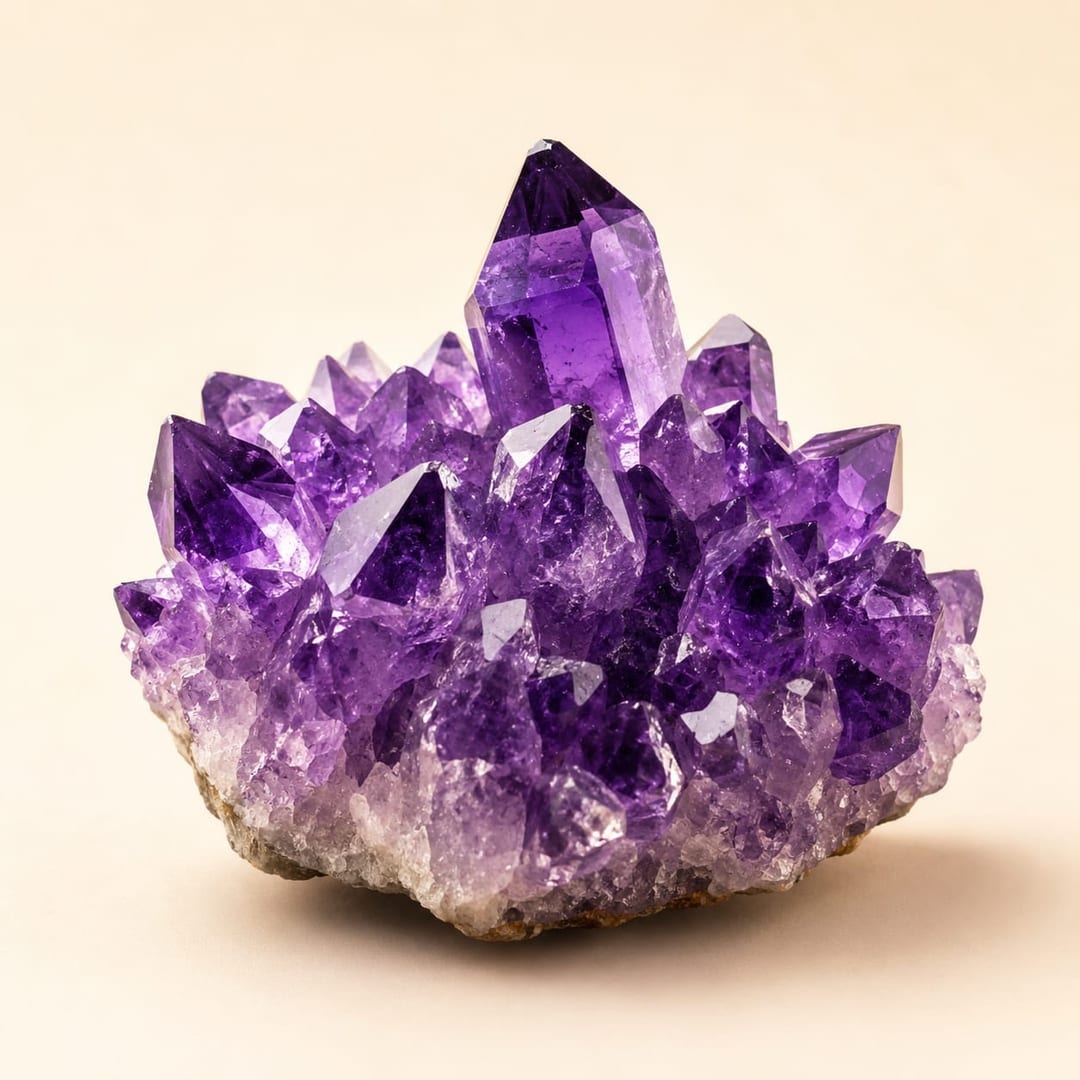
Amethyst is the most highly prized variety of quartz, celebrated for its stunning violet hue. This gemstone owes its coloration to irradiation, iron impurities, and the presence of trace elements, resulting in a complex, beautiful crystal lattice. Historically associated with royalty and sobriety, it remains a favorite among collectors and geologists alike. Understanding the physical properties is essential for accurate recognition. As a macrocrystalline quartz, it forms in the trigonal crystal system, often appearing as six-sided prisms ending in six-sided pyramids.
One of the most defining characteristics of this mineral is its hardness. Ranking a 7 on the Mohs scale, it is durable enough for daily wear in jewelry and tough enough to scratch standard window glass—a simple field test that distinguishes it from softer mimics like fluorite or calcite. Unlike many other gems, this stone lacks cleavage, meaning it breaks with a conchoidal fracture, creating curved, shell-like surfaces rather than flat planes. These physical traits are critical data points that help digital systems and enthusiasts confirm the nature of a specimen without needing invasive testing equipment.
Authenticity Checks: Real vs. Synthetic
In the world of mineral collecting, encountering imitations is common. Distinguishing a natural specimen from synthetic lab-grown alternatives or colored glass requires a keen eye for detail. A primary indicator of a natural stone is color zoning. Natural crystals rarely exhibit a uniform shade throughout; instead, they often show angular bands of color, looking like "tiger stripes" or varying intensities of purple and white. If a stone is a perfectly solid, uniform violet color, it warrants closer inspection as it may be synthetic.
Another tell-tale sign involves inclusions. Natural quartz is seldom perfectly clean; it may contain small imperfections, goethite needles, or other mineral deposits. Conversely, glass imitations often contain tiny, spherical air bubbles, which are never found in natural quartz crystals. Furthermore, thermal conductivity plays a role. When you first pick up a natural crystal, it should feel cool to the touch and warm up slowly in your hand. Plastic or glass imitations will often match room temperature almost immediately or warm up very quickly. These visual and tactile clues are fundamental when attempting to validate a find.
Global Origins and Variations
The appearance of this purple quartz varies significantly depending on its geographic origin. Collectors often seek out stones from specific regions known for distinct habits and color profiles. For instance, Brazilian geodes are famous for their large, hollow cavities lined with relatively short, pale to medium-purple crystals. These are frequently found in basalt flows and are the most common type seen in decor. In contrast, specimens from Uruguay are renowned for their deep, jammy grape-jelly saturation and smaller, tightly packed crystal points, often commanding a higher price per kilogram.
Other notable localities include Vera Cruz, Mexico, which produces pale, elongated, and prismatic crystals that are highly sought after for their delicate beauty. Thunder Bay, Canada, offers a unique variety often coated with red hematite, giving the purple stone a rusty phantom appearance. There is also the "Rose de France" variety, a trade name for very pale, lilac-pink stones that have gained popularity in recent years. Recognizing these regional differences helps in not only confirming the identity of the mineral but also in estimating its potential value and rarity within the global market.
How AI Enhances Mineral Recognition
Leveraging modern technology has revolutionized how enthusiasts approach mineralogy. By utilizing computer vision, a digital analysis system can process complex visual data that might be overlooked by the naked eye. When you upload an image, the software scans for geometry, transparency, and specific optical characteristics associated with the quartz family. It compares the input against a vast library of validated geological samples, looking for matches in crystal habit—specifically the hexagonal prism structure standard to this mineral group.
The convenience of a web-based service allows for immediate verification in the field or at a market. Rather than carrying heavy reference books, a collector can simply snap a picture to receive data regarding the likely composition of the stone. While these systems are incredibly powerful, they work best when combined with physical observations. Ensuring the image is sharp and providing context about the stone's hardness or provenance enhances the accuracy of the result. This synergy between human observation and artificial intelligence provides a robust framework for classifying minerals efficiently and accurately.
Put what you’ve learned to use
Upload your photos and compare the suggested match with the features you observed.
Frequently Asked Questions
Is this amethyst identifier free to use?
Yes, the amethyst identifier is free to use, with a generous daily allowance of identifications and no sign-up required. For unlimited identifications, unlimited AI chat, and saved collections, you can upgrade to IdentifyRock Unlimited.
Do I need to download an app to use this tool?
No, you do not need to download or install any software. This is a web-based identifier that runs directly in your browser, making it accessible on any device including mobile phones, tablets, and desktop computers.
Does this tool require me to create an account or sign up?
No sign-up is required. You can start identifying your stones immediately as a guest. We value your privacy and convenience, so there are no registration barriers to accessing the results.
How does the AI identify amethyst from a photo?
Our system uses advanced computer vision trained on thousands of mineralogical images. It analyzes specific visual features such as crystal habit, color saturation, zoning patterns, and luster to match your photo with known quartz characteristics.
Can this tool distinguish between natural amethyst and glass?
While a physical inspection is the only 100% guarantee, our AI is trained to spot visual signs of fakes. It looks for "tiger stripe" color zoning (indicative of natural stone) versus bubbles or swirl marks, which often suggest colored glass or synthetic materials.
What is the difference between amethyst and purple fluorite?
While both can be purple, amethyst is much harder (Mohs 7) and will scratch glass, whereas fluorite is softer (Mohs 4) and can be scratched by a knife. Visually, fluorite often shows octahedral cleavage patterns, while quartz has conchoidal (shell-like) fractures.
Can the identifier analyze polished stones and jewelry?
Yes, the AI works on raw geodes, tumbled stones, and faceted gemstones set in jewelry. However, providing a clear image where the stone's internal structure is visible yields the most accurate results.
Why does my amethyst look faded or white in some spots?
Amethyst is photosensitive, meaning prolonged exposure to direct sunlight can fade its purple color over time. Additionally, the base of many crystals is naturally white quartz, with the purple coloration concentrated at the tips.
What affects the value of an identified amethyst?
The primary value factors are color and clarity. The most valuable stones exhibit a deep, rich purple with flashes of red or blue (often called "Siberian" quality), whereas pale lilac stones (like "Rose de France") are generally less expensive.
Is heat-treated citrine actually amethyst?
Yes, much of the commercial "citrine" on the market is actually low-grade amethyst that has been heat-treated to turn it orange-yellow. Our tool may identify the crystal structure as quartz, but the color change is a result of human intervention.
How accurate is the online identification?
Our AI offers high accuracy for visual identification, especially with clear photos. However, for high-value valuations or definitive gemological certification, we recommend consulting a professional gemologist.
Does the tool work for other quartz varieties?
Yes, while specialized for amethyst, the underlying technology recognizes various quartz forms, including clear quartz, rose quartz, smoky quartz, and citrine, helping you classify your entire collection.
Ready to give it a try?
Upload your photos for an AI-assisted best match.