Agate Identifier
Instantly Identify Agates, Chalcedony, and Geodes with High-Accuracy AI Analysis
Identification form
Upload agate photos
Clear, well-lit images help the AI identify it more accurately.
Unlock Unlimited Access
- Unlimited Identifications
- Unlimited AI Chat Messages
- Save and Organize Your Collection
How to Identify Agates by Photo
- 1
Snap a Clear Photo
Click "Upload Images" to select a photo of your specimen. For the most accurate agate analysis, ensure the stone is well-lit (natural daylight is best) and placed on a plain background. Avoid shadows that obscure the banding.
- 2
Capture Details & Angles
Upload extra photos to help the AI. Close-ups of the distinct banding, moss-like inclusions, or drusy quartz centers provide vital clues. Tip: Wetting the agate can reveal hidden colors and translucency.
- 3
Provide the Location
Tell us where the rock was found. Geography is a key factor—a Lake Superior Agate is geologically distinct from a Botswana Agate found in Africa.
- 4
Add Observations
Input specific traits to narrow down the results. Note if the stone is translucent when held to light, has a waxy luster, or if it scratches glass (indicating quartz hardness).
- 5
Get Instant Results
Click "Identify Agate" to start the analysis. Our system will compare your photos against thousands of mineralogical samples to provide the closest matches.
Ready to identify it?
Upload one or more clear photos to get started.
Understanding Agate Characteristics
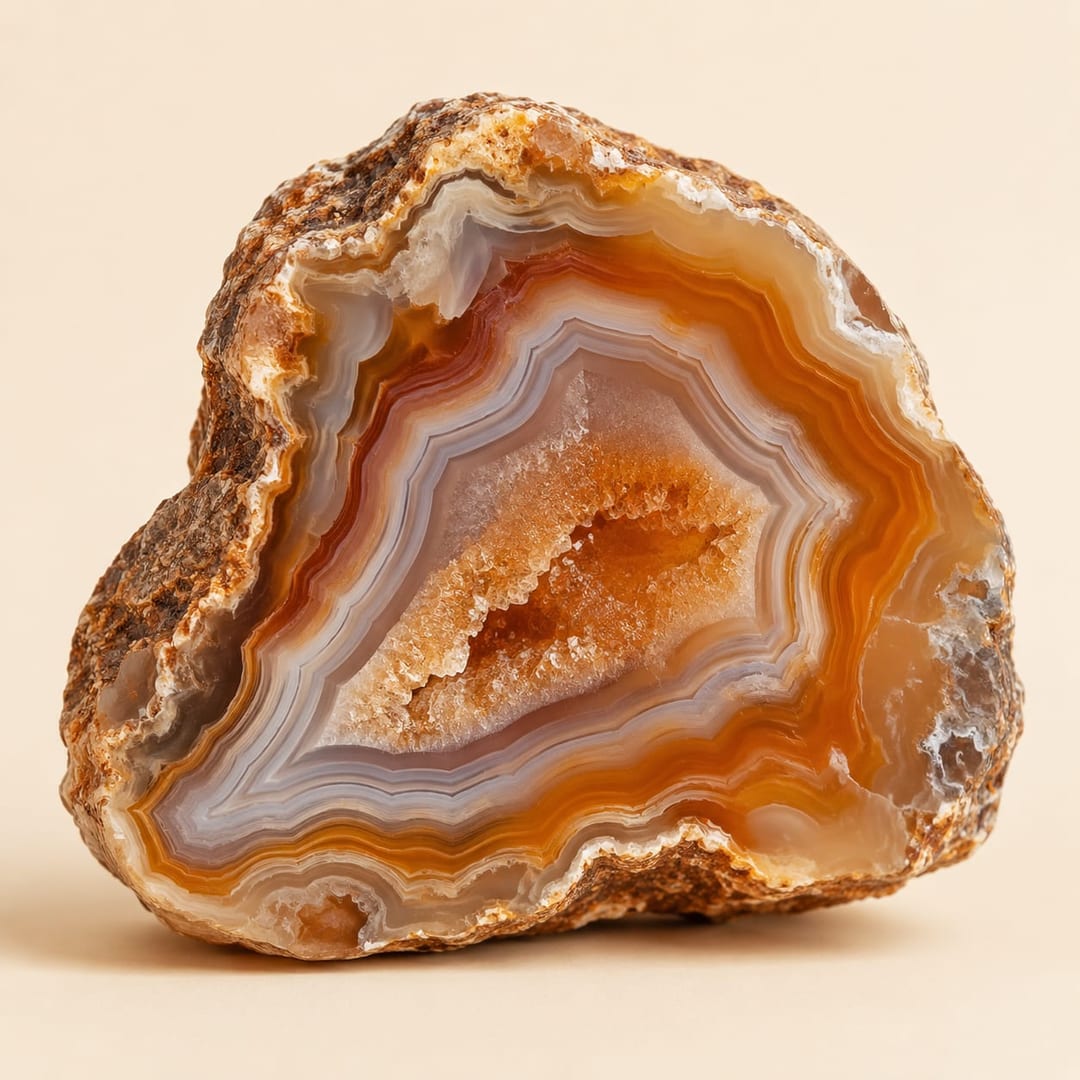
Agates are among the most varied and sought-after semi-precious stones found in the world. To the untrained eye, a rough agate might look like a common rock, but understanding its geological definition helps in distinguishing it from other minerals. Agate is a variety of chalcedony, which is a cryptocrystalline form of silica (quartz). The primary characteristic that separates agate from other forms of chalcedony is its distinctive banding. These bands are formed by rhythmic deposition of silica-rich fluids in cavities within volcanic rocks or ancient lavas.
When you are examining a specimen, the first thing to look for is translucency. Unlike jasper, which is generally opaque and blocks light, most agates will allow some light to pass through, especially around the edges. This optical property, combined with a waxy luster and a hardness of roughly 7 on the Mohs scale, makes them durable and excellent for polishing. The bands can appear as concentric circles (like tree rings), straight lines (onyx), or chaotic patterns (crazy lace). Recognizing these physical properties is the first step in successful mineral analysis, allowing collectors to separate high-quality specimens from common gravel.
Common Varieties and Locations
The world of agates is incredibly diverse, with hundreds of named varieties often linked to their geographical origin or visual patterns. A reliable digital helper can assist in sorting these varieties, but knowing the key types is beneficial for any collector. Moss Agate, for instance, is technically not a banded agate but is included in the family due to its chemical composition; it features green, moss-like mineral inclusions made of manganese or iron oxide. Fire Agate is another distinct variety, known for its iridescent flashes of color caused by layers of iron oxide and limonite within the silica structure.
Geographic varieties are also famous among enthusiasts. The Lake Superior Agate, the official state gemstone of Minnesota, is known for its rich red, orange, and yellow banding derived from iron oxidation. Botswana Agate is prized for its tight, precise white and gray banding. Blue Lace Agate, found primarily in Namibia, exhibits delicate light blue stripes. Identifying these specific types often requires looking at the color palette and the specific style of the patterns. While a general analysis might confirm a stone is an agate, close observation of these unique traits helps pinpoint the exact subspecies.
Distinguishing Agate from Lookalikes
One of the biggest challenges for rockhounds is distinguishing agates from similar-looking stones like chert, flint, jasper, and even calcite. The most frequent confusion occurs between agate and jasper. Both are varieties of chalcedony, but the distinction lies in diaphaneity. If you hold a flashlight behind the stone and light shines through the material, it is likely agate. If the light is completely blocked, it is classified as jasper. However, some stones can be a mix, often called 'jasp-agate.'
Another common lookalike is banded calcite. While it mimics the layered look of agate, calcite is significantly softer. Agate will scratch standard glass, whereas calcite will be scratched by a steel knife or a coin. Additionally, common opal can resemble agate but lacks the crystalline structure and distinct banding. Finally, be wary of slag glass, which is industrial waste. Slag often has bubbles and typically lacks the natural, waxy feel of genuine chalcedony. Using a digital recognition resource can help flag these imposters by analyzing the texture and fracture patterns—agates typically exhibit a conchoidal fracture (curved breakage) which is distinct from the cleavage of calcite.
Tips for Accurate Photo Analysis
To get the most out of any automated recognition system, the quality of your input is crucial. Agates are complex stones with intricate details that can be easily washed out in poor lighting. When preparing your specimen, the most effective trick is to wet the stone with water. A wet surface reduces light scattering and makes the internal colors and banding pop, simulating how the stone would look if it were polished. This allows the computer vision algorithms to detect patterns that might be invisible on a dry, dusty surface.
Lighting should be diffuse and bright. Direct, harsh sunlight can create deep shadows that obscure texture, while dim indoor lighting adds grain/noise to the image. A cloudy day offers the perfect natural lighting conditions. Furthermore, try to capture the 'face' of the stone that shows the most variation. If the rock is broken, photograph the fracture surface rather than the weathered exterior rind. By providing high-quality visual data, you ensure that the technology can analyze the crystal habits and structural nuances effectively, leading to a much higher confidence rate in the final result.
Put what you’ve learned to use
Upload your photos and compare the suggested match with the features you observed.
Frequently Asked Questions
Is this agate identifier free to use?
Yes, the agate identifier is free to use, with a generous daily allowance of identifications and no sign-up required. For unlimited identifications, unlimited AI chat, and saved collections, you can upgrade to IdentifyRock Unlimited.
Do I need to download an app to use this?
No, this is a web-based online application. You do not need to download or install any software. It works directly in your browser on both mobile and desktop devices.
Is there a limit to how many agates I can identify?
The free version includes a generous daily allowance of identifications, plenty for most beach finds. To sort through large buckets without a daily cap, plus unlimited AI chat and saved collections, you can upgrade to IdentifyRock Unlimited.
Do I need to create an account or sign up?
No sign-up is required. You can start identifying your stones immediately without providing an email address or creating a user profile.
How does the AI identify the agates?
Our system uses advanced computer vision trained on a vast database of mineral images. It analyzes texture, color patterns, banding, and translucency to match your photo with known agate varieties.
Can it differentiate between agate and jasper?
Yes. While both are forms of chalcedony, the AI looks for translucency (common in agates) versus opacity (common in jasper) to help distinguish between the two.
What is the best way to photograph an agate for identification?
Use natural, indirect sunlight. If the stone is translucent, try backlighting it to show the internal structure. Ensure the image is in focus and crop out background clutter.
Can it identify raw, unpolished agates?
Yes, the model is trained on both rough and polished specimens. However, washing off dirt and wetting the stone will significantly improve accuracy for raw specimens.
Does it recognize specific types like Moss or Fire Agate?
Yes, the AI is capable of recognizing specific sub-varieties such as Moss Agate, Dendritic Agate, Fire Agate, and Blue Lace Agate based on their unique visual characteristics.
Is the identification 100% accurate?
While highly accurate, AI analysis should be used as a guidance tool. For high-value specimens, we recommend consulting a professional geologist or gemologist.
Can I use this on my phone while rockhounding?
Absolutely. The website is fully responsive and mobile-friendly, allowing you to take a photo and get results while you are out in the field.
Is my photo data private?
Yes, your privacy is important. Images are processed for analysis and are not permanently stored in a public gallery without your permission.
Ready to give it a try?
Upload your photos for an AI-assisted best match.